Leave Your Message

China Top 10 Automatic Chain Making Machine Manufacturers

China’s chain-making sector serves jewelry workshops, hardware producers, and industrial suppliers. An Automatic Chain Making Machine can form wire into links and join them with repeatable motion. Yet speed alone does not define a good fit. Wire diameter, chain pattern, tooling, and operator setup all affect finished quality.

This overview introduces ten Chinese manufacturers for buyers comparing equipment options. It is a starting point, not a universal ranking. Machine capabilities vary, even within one supplier’s product range. Check whether a model supports your chain style, target output, and material before comparing prices. Ask for a sample run using the wire and specifications you actually plan to use. A short demonstration helps.

Look closely at the details. Consistent link spacing, clean joints, and stable operation across a shift can reveal more than a brochure. Buyers should also ask about changeover time, control systems, spare parts, training, and service response. Clear technical documents and specific answers are useful signs of a dependable supplier, though they cannot guarantee a trouble-free purchase. A small caveat: published output figures may reflect ideal conditions, not everyday production.

The manufacturers profiled here can help narrow the search, but careful checks remain essential. Compare models against your own production needs, request current specifications, and confirm support arrangements directly with each company. The right machine is not always the fastest. It is the one that fits the work, the operators, and the workshop’s real constraints.
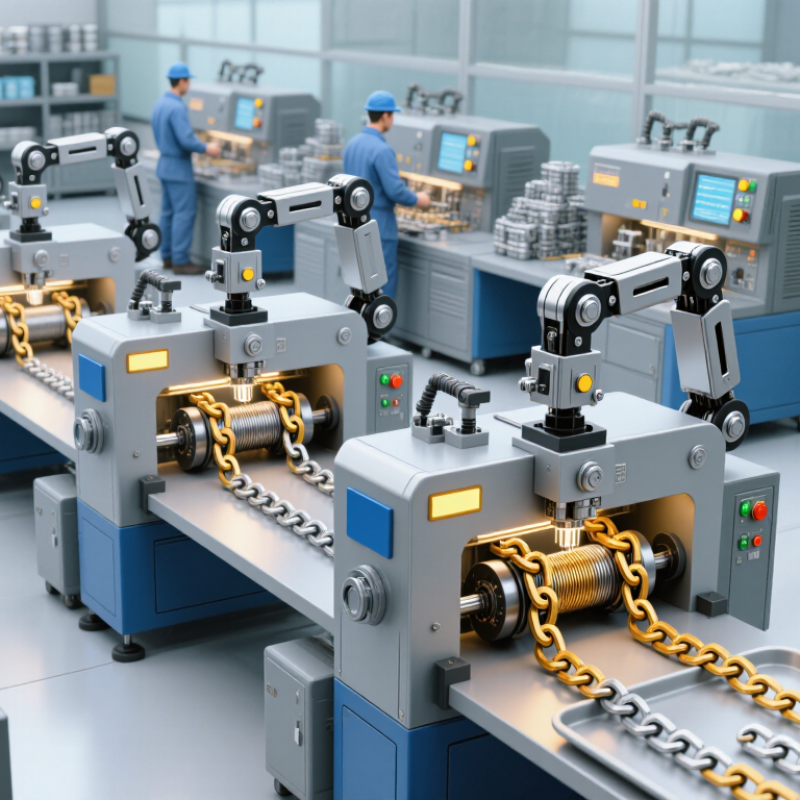
China Top 10 Automatic Chain Making Machine Manufacturers

China’s Automatic Chain Making Machine Industry at a Glance

China’s automatic chain-making machine industry serves jewelry, hardware, and industrial component producers. Across the sector, equipment ranges from compact units for small workshops to integrated lines designed for steady production. Typical systems feed wire, form links, and join them through controlled processes. The result depends on more than machine speed. Wire thickness, material consistency, and link geometry all affect the finished chain. Small variations matter.

Manufacturing capability can differ between suppliers, so buyers should examine the actual machine and its output. Ask to see sample chains made with comparable wire and link dimensions. Check whether the machine allows adjustments to forming pressure, feed length, and joining parameters. Cycle-speed figures need context. A fast setting may increase rejects if setup is poor or incoming wire varies.

Reliable service also matters after installation. Clear operating instructions, accessible spare parts, and practical operator training can reduce downtime. A factory visit or live production trial may reveal details that a brochure misses, such as noise, changeover time, or how easily an operator clears a jam. Still, automation is not a cure-all. Some production runs need frequent tuning, and that can erase expected gains. Buyers should compare usable output, maintenance needs, and support conditions—not just the quoted speed.
Machine Types, Production Processes, and Core Technologies

Automatic chain-making machines differ by chain design and production volume. Wire-forming systems suit light decorative chains, while link-forming and welding lines handle heavier industrial chains. Some machines combine feeding, cutting, bending, and closing; others require separate stations. Check the wire diameter range, link dimensions, and changeover time against real samples, not only catalogue specifications. A machine that runs quickly on one size may struggle with another.

Production usually begins with wire straightening and controlled feeding. A cutter sets each link length, forming tools shape it, and a closing or welding station joins the ends. Calibration helps maintain consistent pitch and link shape. Depending on the application, heat treatment and surface finishing follow. Servo-driven feeds, programmable controls, and sensors can improve repeatability and detect missed links. Still, automation does not remove the need for careful die setup. Small alignment errors can create visible defects across a long run.

Tips: Ask manufacturers to run your material and target chain size during a factory test. Record output per hour, rejection rate, setup time, and noise levels. Bring sample links for comparison. A fast cycle is not enough. Honestly, one specification rarely tells the full story; maintenance access and operator training matter, too.

How to Evaluate Automatic Chain Making Machine Manufacturers

Choosing among China’s automatic chain making machine manufacturers requires more than comparing prices. Ask for a production trial using the wire size and chain design you expect to run. Watch the feeder, forming stations, and cutting mechanism through a full cycle. Do the links stay consistent at normal operating speed? Small details matter. Check sample chains for smooth joints, uniform pitch, and burrs. Request measured samples, not only a polished demonstration piece.

Assess engineering support alongside machine performance. Ask which adjustments operators can make, how long routine changeovers take, and whether setup instructions include clear diagrams. Confirm the stated output rate under conditions similar to your workshop, rather than relying on a peak-speed figure. Clear answers help. Review the spare-parts list and response process before placing an order. A checklist still has limits: a short trial cannot reveal every maintenance issue, and your material may behave differently in daily production. Leave time to verify the machine with your own specifications and ask the supplier to explain any results that seem unusually favorable.

China Top 10 Automatic Chain Making Machine Manufacturers - How to Evaluate Automatic Chain Making Machine Manufacturers

Use these ten criteria to compare manufacturers consistently. The framework is for evaluation and does not rank or identify individual companies.

No. Evaluation Dimension What to Check Evidence to Request or Verify
1 Chain and product compatibility Confirm that the machine is designed for the required chain type, link geometry, material, wire or stock dimensions, and target product range. A machine configured for one chain design may not produce another without tooling or setup changes. Product drawings, supported-size range, material specifications, tooling list, and sample links produced using the proposed configuration.
2 Verified production capacity Compare output using the same chain specification and operating conditions. Clarify whether the quoted rate is a maximum machine speed or sustained acceptable output, and account for stops, adjustments, and scrap. A witnessed production test or recorded trial showing operating time, good pieces produced, rejected pieces, and the test configuration.
3 Link consistency and process capability Check the dimensions and functional characteristics that matter for the finished chain, such as link pitch, shape, joint or closure condition, and fit with adjoining links. Define tolerances against the buyer’s product drawings. Measured samples from a production run, inspection records, measurement methods, and an agreed acceptance plan.
4 Automation and controls Review feeding, forming, joining or closing, monitoring, and fault-handling functions included in the supplied machine. Confirm which operations are automatic and which require operator intervention. Process-flow description, control-system specifications, operating demonstration, alarm list, and a clear statement of included and optional functions.
5 Setup and changeover Establish how the machine is adjusted when changing chain sizes or product designs, what tooling is required, and whether settings can be documented and repeated. Changeover time depends on the machine, tooling, product, and operator. Demonstration of a representative changeover, tooling and adjustment instructions, and a written list of required tools and replacement parts.
6 Quality assurance and traceability Assess how incoming materials, in-process production, finished chain, and nonconforming output are checked. Determine whether inspection results can be linked to a production batch or job. Sample inspection forms, measurement-device calibration records where applicable, documented quality procedures, and an example batch record.
7 Machine safety and electrical documentation Review guarding, emergency stops, operating instructions, electrical documentation, and the risk controls relevant to the machine’s intended use and destination. Applicable legal and technical requirements depend on the market. Risk assessment, safety-device list, wiring diagrams, manuals, and relevant conformity documentation. ISO 12100 addresses machinery risk assessment and risk reduction; IEC 60204-1 covers electrical equipment of machinery.
8 Reliability and maintainability Check access for routine cleaning, lubrication, inspection, and replacement of wear parts. Ask which components are considered consumables and how maintenance intervals are determined. Maintenance schedule, recommended spare-parts list, parts identification drawings, and service records or references for comparable machine types.
9 Installation, training, and after-sales support Confirm the scope and timing of installation and commissioning, operator and maintenance training, remote support arrangements, and the process for obtaining technical assistance and parts. Written service scope, training plan, support hours and contact channels, warranty terms, and quoted lead times for critical spare parts.
10 Total cost and commercial clarity Compare the complete cost of ownership rather than purchase price alone. Include tooling, installation, training, shipping, utilities, maintenance, spare parts, and any options needed to meet the production requirement. Itemized quotation, stated exclusions, delivery and payment terms, warranty conditions, utility requirements, and a documented list of required options and consumables.

Comparison method: Apply the same product specification, acceptance criteria, and operating conditions to every supplier. Record evidence for each criterion and treat unverified claims as pending rather than confirmed.

Ten Notable Automatic Chain Making Machine Manufacturers in China

China Top 10 Automatic Chain Making Machine Manufacturers

Ten Notable Automatic Chain Making Machine Manufacturers in China

China’s automatic chain-making machine sector serves jewelry workshops, hardware producers, and industrial suppliers. Notable manufacturers differ in the chain sizes they support, their forming methods, and how much production they automate. A useful comparison looks beyond machine speed. Check whether wire feeding, link forming, welding, and sizing work smoothly together.

Details matter. Ask for sample runs using your own wire diameter and material. Watch how consistently links close, and whether the machine needs frequent adjustment. A clear control interface helps operators change settings without guesswork. Ask about spare parts, operator training, and service response times. These practical details can affect daily output as much as a machine’s advertised capacity.

A manufacturer’s experience is best judged through verifiable technical information, production demonstrations, and customer references where available. Request specifications for tolerances, power needs, and routine maintenance. A neat showroom is not enough. Nor is a fast cycle-time figure. Some product pages leave questions unanswered, so buyers should verify claims directly and record trial results before comparing suppliers. The right fit depends on the chain design, production volume, and skill level of the operators. Even a capable machine may need a learning period.

Applications, Customization, and Buyer Considerations

Automatic chain-making machines serve jewelry, conveyor, agricultural, and general industrial production. The application determines wire diameter, material grade, link geometry, joining method, and finish requirements. Fine jewelry chains need consistent, small links; conveyor chains prioritize load capacity and repeatable pitch. These differences affect tooling, feeding, forming, welding, and inspection. The International Federation of Robotics’ World Robotics 2024 reports 4.28 million industrial robots operating worldwide in 2023, up 10% year over year. This is a broad automation indicator, not a measure of chain-machine sales. Grand View Research estimated the global industrial automation market at US$205.86 billion in 2022, another broad measure rather than a chain-specific forecast.

Customization should begin with actual production samples, not a catalog speed target. Ask for trials using your wire and representative chain designs. Record good links per minute, dimensional variation, scrap rate, and changeover time. Small details matter. Confirm the machine’s wire range, tooling-change process, guarding, maintenance access, spare-parts availability, and operator training. Request a documented acceptance test with agreed quality limits. A buyer can still over-specify speed and under-test changeovers; that is an easy mistake. Check whether the line handles planned product changes without costly tooling replacement. Independent testing and clear service terms make supplier comparisons more reliable.

China’s Automatic Chain-Making Machine Market: Applications, Customization & Buyer Considerations

Typical Automated Chain-Making Workflow

This schematic shows a common production sequence, not a ranking of manufacturers or a measured performance comparison. Actual steps vary by chain design: some products require welding, while others may use different forming, joining, or finishing processes. When evaluating equipment, buyers should confirm material and size compatibility, required output, changeover needs, customization options, and after-sales support.