
Leave Your Message
Choosing among China’s Top 10 Basic Jewelry Making Tools Suppliers takes more than comparing catalog prices. A supplier’s pliers may look identical online, yet differ in jaw alignment, hinge smoothness, and grip comfort. Those differences show up when you bend wire repeatedly or close a tiny jump ring. Basic Jewelry Making Tools should feel dependable in the hand, not merely look polished in product photos.
Jewelry-tool sourcing consultant Lin Wei offers a practical rule: “Test the tool on real work, not just on a supplier’s specification sheet.” That advice is useful, though no single sample proves consistent production quality. This guide compares suppliers by product range, material details, sample availability, customization options, communication, and quality-control practices. It also considers whether a supplier can explain steel grades, handle finishes, and replacement policies clearly. Small details matter. A rough file edge or loose cutter joint can waste time and damage delicate components. Buyers should request samples and confirm specifications before placing larger orders. Ask how measurements are checked, and whether packaging protects pointed or polished tools in transit. Some supplier pages offer limited technical detail; that is a reason to ask questions, not assume poor quality. The list is a starting point, not a guarantee. Tool fit is personal, and a lower price can still cost more in rework.
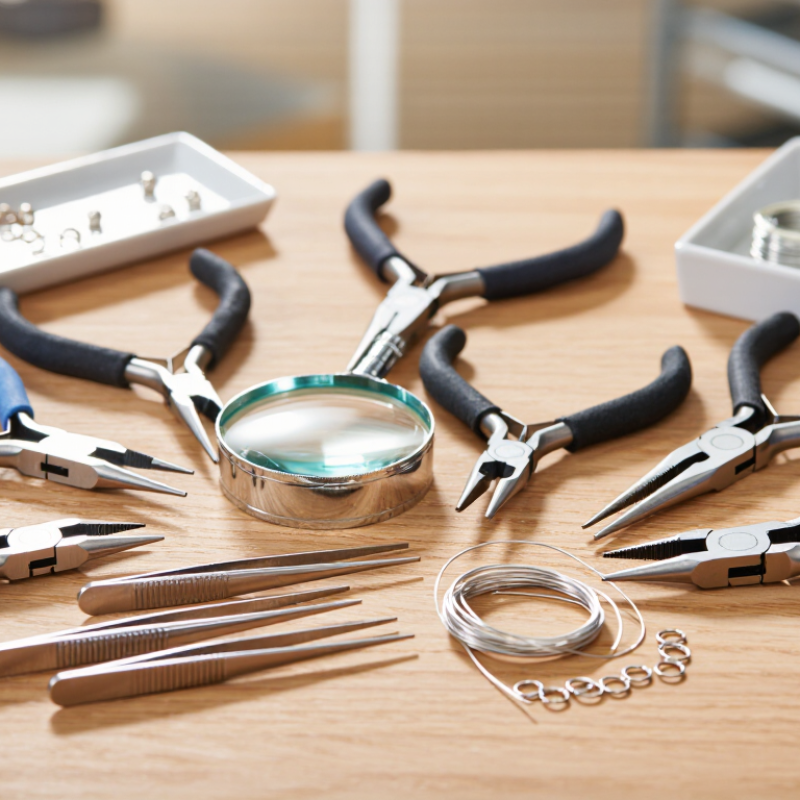
Basic jewelry making tools each solve a different bench problem. Round-nose pliers form loops; their tapered jaws help control loop size. Flat-nose pliers grip wire and close jump rings, while flush cutters trim wire close to a finding. A steel mandrel supports ring sizing and shaping. Needle files smooth sharp edges, and digital calipers check wire diameter or component dimensions. Keep cutters separate from gripping pliers. It is a small habit, but it helps preserve clean cutting edges.
Grand View Research estimated the global jewelry market at USD 353.26 billion in 2023 and projected a 4.7% compound annual growth rate from 2024 to 2030. This figure describes jewelry, not tool demand, but it signals the scale of work those tools support. When comparing Chinese suppliers, ask about jaw alignment, material specifications, dimensional tolerances, and sample inspection. Test pliers on scrap wire: uneven jaws may leave marks, even when the tool looks polished. Handle comfort matters, too, though it is easy to overrate a smooth finish. A simple trial often reveals more than a product photo.
| No. | Basic Tool | Core Function | Typical Jewelry Applications | Practical Selection Notes |
|---|---|---|---|---|
| 1 | Round-Nose Pliers | Forms smooth loops and curves by wrapping wire around tapered, rounded jaws. | Making eye pins, jump rings, wire links, and decorative wire shapes. | Choose smooth, aligned jaws to reduce marks on wire. A tapered profile supports different loop sizes. |
| 2 | Chain-Nose Pliers | Grips, bends, and positions wire or small findings; the narrow jaws can reach confined areas. | Opening and closing jump rings, holding wire ends, and assembling components. | Flat, smooth inner jaws help avoid scratching metal. Two pairs are useful for opening jump rings securely. |
| 3 | Flat-Nose Pliers | Provides a broad, flat gripping surface for straightening, flattening, and making firm bends. | Shaping wire, holding flat components, and adjusting metal findings. | Look for jaws that meet evenly and have smooth working surfaces for better control. |
| 4 | Flush Cutters | Cuts soft jewelry wire with one relatively flat cut and one angled cut. | Trimming copper, silver, and craft wire during assembly. | Use only within the cutter's stated material and wire-size capacity. Do not use on hardened steel or piano wire. |
| 5 | Wire-Wrapping Mandrel | Provides a consistent form around which wire can be wrapped to create coils or rings. | Making wire coils, ring-shaped components, and repeatable curved forms. | A graduated mandrel offers several forming diameters; choose a material and surface that will not damage the wire. |
| 6 | Jewelry Saw Frame | Holds a fine saw blade under tension for controlled cutting of sheet metal and other suitable materials. | Cutting metal sheet, trimming shapes, and making detailed openings. | Match blade size to material thickness and task. Wear eye protection and keep the blade properly tensioned. |
| 7 | Jeweler's Files | Removes small amounts of material and smooths edges after cutting or shaping. | Refining metal edges, smoothing cut ends, and adjusting small components. | Different profiles—such as flat, half-round, and round—reach different contours. Use a file suited to the material. |
| 8 | Bench Block | Provides a hard, stable surface for hammering, flattening, and shaping small metal pieces. | Flattening wire, texturing metal, and supporting small components during forming. | A hardened steel block offers a firm surface; keep it clean and secure it on a stable workbench. |
| 9 | Jeweler's Hammer | Applies controlled impact for forming, flattening, or texturing metal, depending on the hammer face. | Shaping wire and sheet metal, work-hardening suitable pieces, and adding surface texture. | Use a face appropriate to the job and strike on a suitable bench block. Work gradually to maintain control. |
| 10 | Digital Caliper | Measures external dimensions, internal dimensions, and depth within the instrument's range. | Checking wire diameter, component dimensions, ring-related measurements, and tolerances. | Zero the caliper before measuring and avoid excessive pressure on delicate pieces. Confirm dimensions with the tool's stated accuracy. |




 Lily
 Jason wong