


 Lily
Lily Jason wong
A Legacy of Precision: 20+ Years in Chain Weaving R&D
For more than two decades, our company has stood at the forefront of the jewelry manufacturing industry as a premier chain weaving machine manufacturer. Over the past 20 years, our dedicated Research and Development team has witnessed and driven monumental shifts in how precious metals are transformed into intricate, durable, and beautiful chains. The journey from manual craftsmanship to automated mechanical weaving was our first major milestone, but today, we are navigating an even more profound technological leap: the transition from traditional welding to advanced laser welding technology.
In the highly competitive world of jewelry production, efficiency, precision, and aesthetic perfection are not just goals—they are strict requirements. The chains we wear—whether they are delicate O-chains, complex Chopin chains, or robust Cuban links—require thousands of individual links to be perfectly closed and secured. Historically, this was achieved through traditional thermal welding methods. However, as global demand scales and the designs of precious metal jewelry become increasingly sophisticated, the limitations of traditional welding have become a critical bottleneck for manufacturers worldwide.
Recognizing this industry-wide challenge, our R&D department has heavily invested in integrating cutting-edge photonic solutions into our chain weaving machines. By embedding advanced QCW (Quasi-Continuous Wave) fiber lasers directly into our automated systems, we have fundamentally rewritten the rules of chain manufacturing. This comprehensive guide explores the profound changes laser welding has brought to chain weaving machines, comparing it meticulously against traditional methods, and detailing how our latest technological integrations—specifically the 150W QCW Fiber Laser—are setting new global standards.
Breaking the Bottleneck: Traditional vs. Laser Welding
To truly appreciate the magnitude of the laser revolution, one must first understand the mechanical and chemical realities of traditional chain welding. For generations, chain weaving machines relied on methods such as TIG (Tungsten Inert Gas) welding, micro-torch soldering, or the application of solder paste followed by furnace heating. While these methods served the industry well for years, they carry inherent physical limitations that restrict modern production capabilities.
Thermal Distortion & Discoloration
Traditional welding relies on broad heat application. When welding gold, K-gold, or platinum, this excessive heat-affected zone (HAZ) often leads to material deformation. Furthermore, the oxidation caused by prolonged heat exposure frequently results in weld blackening or discoloration, requiring extensive and costly post-weld polishing and chemical cleaning to restore the metal's natural luster.
Inconsistent Tensile Strength
In traditional solder-based welding, the joint relies on a secondary alloy with a lower melting point. This introduces a structural weakness into the chain. Over time, these solder joints can become brittle, leading to a higher rate of chain breakage. Maintaining consistent tensile strength across millions of welded links is nearly impossible with traditional thermal dynamics.
Production Speed Limits
Traditional welding requires longer heating and cooling cycles. When integrated into an automated chain weaving machine, the welding module often becomes the pacing factor, artificially capping the machine's maximum output speed. Manufacturers are forced to choose between production volume and weld quality.
Enter Laser Welding Technology. By utilizing highly focused beams of coherent light, laser welding melts the base metal directly, creating a fusion weld without the need for secondary solder materials. The energy is delivered in milliseconds, pinpointed to an area as small as a fraction of a millimeter. This drastic reduction in the heat-affected zone eliminates discoloration, preserves the structural integrity of the precious metal, and allows the chain weaving machine to operate at unprecedented speeds.
Spotlight: The 150W QCW Fiber Laser (Model: IMG-FW150)
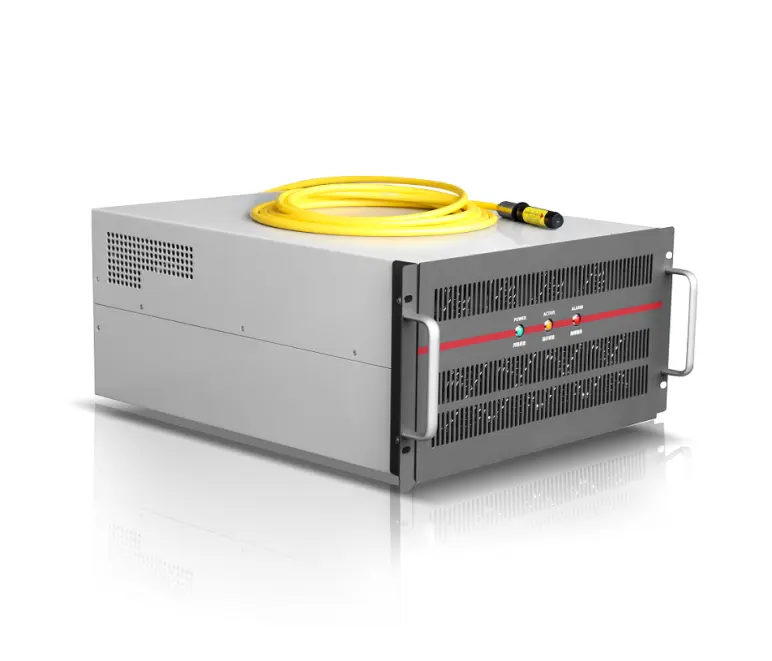
As a leading R&D manufacturer, we do not just build chain weaving machines; we engineer complete, optimized production ecosystems. At the heart of our latest generation of machines is the highly advanced electromagnetic pulse laser, specifically the Model: IMG-FW150. This 150W QCW (Quasi-Continuous Wave) fiber laser represents the ultimate optimization of optical, mechanical, electrical, and software engineering.
Unlike standard Continuous Wave (CW) lasers, QCW technology allows for precise modulation of pulse energy. This means the laser can deliver a massive spike of peak power to overcome the high reflectivity of precious metals like gold and silver, while maintaining a low average power to prevent burning or vaporizing the delicate chain links.
| Core Feature | Technological Advantage | Impact on Chain Weaving |
|---|---|---|
| Real-Time Monitoring | Standard software interfaces allow for live tracking of operational status, data collection, and instant alarm prompts. | Ensures zero-defect manufacturing; automatically stops the machine if welding parameters deviate, reducing scrap rates. |
| Air-Cooled Design | Utilizes an advanced air-cooling radiator instead of bulky water chillers. | Highly compact structure, lower energy consumption, and exceptionally easy for client integration on the factory floor. |
| Energy Stability <1.5% | Ultra-stable power output regardless of environmental fluctuations. | Guarantees that every single link in a gold chain receives the exact same weld penetration, ensuring uniform tensile strength. |
| Adjustable Spot Size | Fiber core diameters ranging from 20-200μm. | Seamlessly switches between welding thick Cuban chains and ultra-fine micro-wire necklaces without hardware changes. |
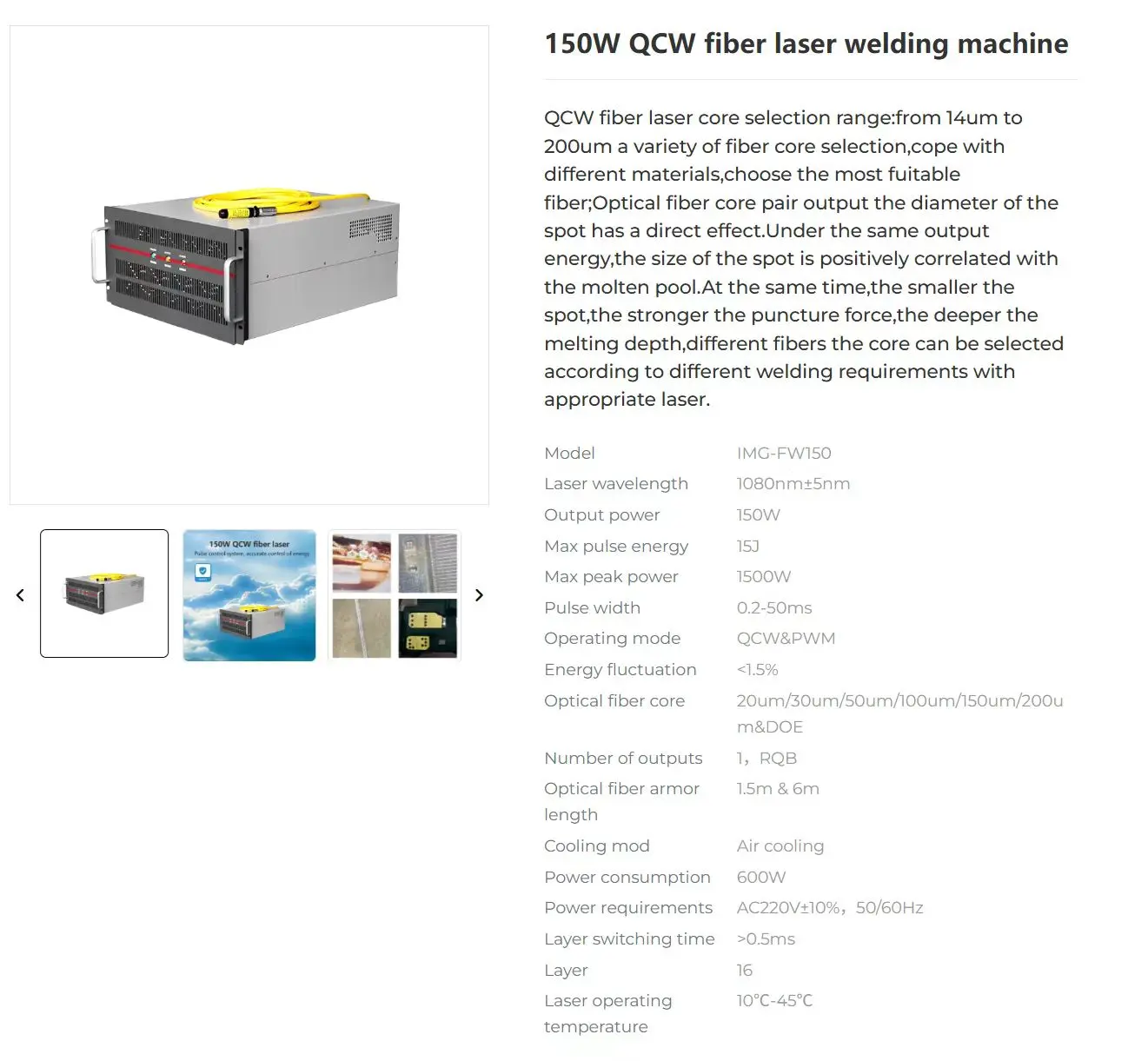
The IMG-FW150 model perfectly addresses the jewelry industry's paradox: the need for a weld that is "both incredibly strong and aesthetically flawless without deformation." When paired with our proprietary chain weaving machines, this laser module reduces rework rates to near zero, offering an unprecedented Return on Investment (ROI) for jewelry manufacturers.
Core Applications in Jewelry Manufacturing
The integration of the 150W QCW Fiber Laser into our chain weaving ecosystem has unlocked versatile applications that extend far beyond basic link closure. Here is a detailed look at how this technology is applied across the jewelry production spectrum:
1. Automated Gold Chain Welding (Primary Scenario)
Serving as the core light source for our chain making machines, it achieves flawless butt welding and lap welding of rings made of pure Gold, K-gold, and Platinum. Whether producing classic O-chains, intricate Chopin chains, or heavy Cuban links, the QCW quasi-continuous mode precisely controls the heat input. This completely avoids material burn-through, discoloration, or blackened joints, while simultaneously guaranteeing the tensile strength of the chain links, making it perfectly adapted for high-speed continuous production.
2. Precision Spot Welding & Assembly
Beyond automated chains, the laser is highly suitable for the component splicing of rings, earrings, bracelets, and pendants. This includes setting welding, clasp fixation, and prong reinforcement. The extremely small heat-affected zone prevents precious gemstones from cracking due to high temperatures, and it reliably prevents the thermal deformation of soft materials like pure gold and 18K gold during manual or semi-automated assembly.
3. Jewelry Repair & Defect Restoration
As an indispensable tool for jewelry after-sales service, the laser can repair sand holes, cracks, and fractures in jewelry. It allows for gold filling and weld reworking without the need for large-area heating. This precision ensures that the original luster, texture, and complex modeling of the jewelry piece are preserved to the maximum extent, saving significant time and material costs.
4. Micro-Wire & Thin-Wall Welding
The system is perfectly adapted for the fusion of ultra-fine gold and silver wires, such as the delicate prongs in micro-setting jewelry, ultra-thin necklace links, and the sealing welding of K-gold thin-walled tubes. By adjusting the spot size through different fiber core diameters (20-200μm), operators can perfectly balance welding strength with supreme aesthetic beauty.
Expanding the Horizon: Broader Industrial Applications
While our primary focus remains on revolutionizing the chain weaving machine sector, the inherent versatility of the same QCW laser technology extends its utility into numerous high-precision industries. The identical principles that make it perfect for gold chains—low heat distortion, high precision, and rapid execution—make it an invaluable asset for other manufacturing fields.
Other expanded applications for this type of QCW laser include the micro-welding of precision hardware parts such as luxury watches and optical glasses. It is also extensively used in the electronics sector for the precision spot welding of micro-electronic components and delicate connectors. Furthermore, it excels in the butt welding, lap welding, and seal welding of various thin-walled metal components, as well as precision drilling and localized fusion of specialized metal alloys.
Certified Quality & 20 Years of Trust
As a manufacturer with over 20 years of dedicated R&D in chain weaving technology, our commitment to innovation is unwavering. The transition from traditional welding to laser integration is not just a product upgrade; it is a paradigm shift in how the world creates jewelry. We strictly adhere to all international manufacturing and customs regulations, ensuring that our advanced machinery reaches our global partners safely and reliably.
Dedicated to pushing the boundaries of automated jewelry manufacturing. From traditional roots to a laser-focused future.